

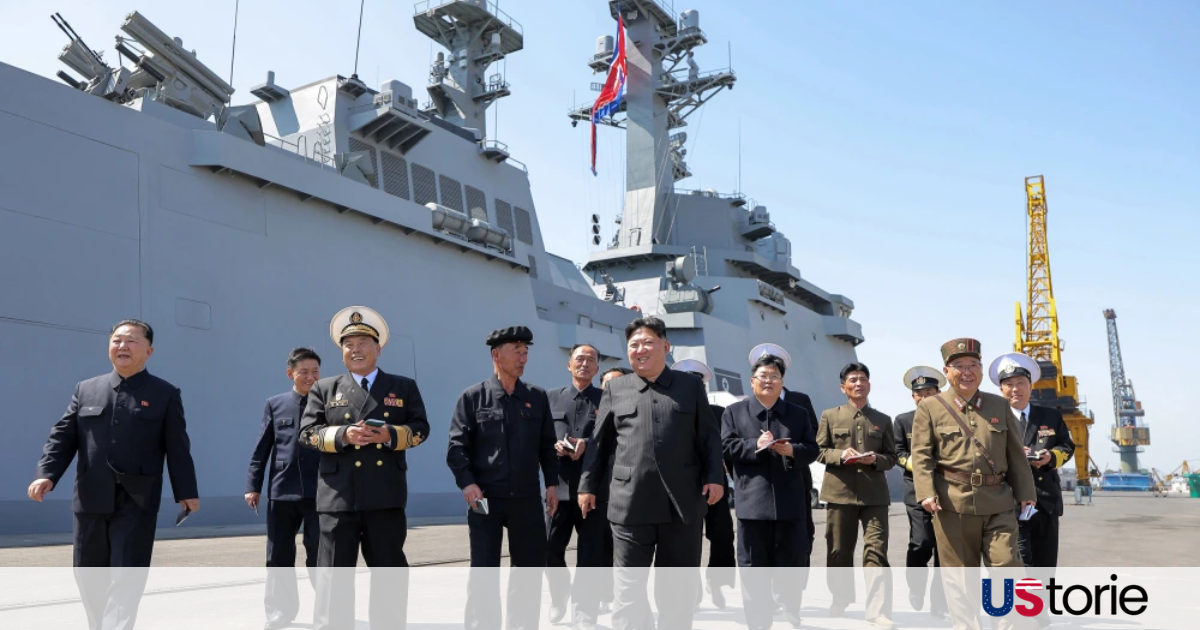
North Korea’s naval capabilities have long been viewed as the “weaker sibling” of its massive land-based missile forces. However, that narrative changed this week as Pyongyang conducted a high-profile demonstration of its maritime strike power. On Sunday, April 12, 2026, Leader Kim Jong Un personally oversaw the test-firing of strategic cruise and anti-ship missiles from the country’s flagship Choe Hyon-class destroyer.
This wasn’t just a routine drill; it was an “operational efficiency trial” designed to prove that the North’s 5,000-ton warships are now fully integrated combat platforms capable of delivering precision strikes deep into the Yellow Sea.
Precision at Sea: The Flight Data
The tests involved two strategic cruise missiles and three anti-warship (ship-to-ship) missiles. According to data released by the state-run Korean Central News Agency (KCNA), the results indicated a high level of technical maturity:
Cruise Missiles: These units flew for approximately 7,900 seconds (over two hours), demonstrating long-range endurance and navigation.
Anti-Ship Missiles: These weapons were airborne for nearly 2,000 seconds (roughly 33 minutes), striking their intended targets with what state media described as “ultra-precision accuracy.”
The primary goal was to verify the integrated weapons command system of the Choe Hyon and to test the “anti-jamming” performance of the vessel’s upgraded navigation hardware.
For an analysis of how these naval advancements impact the balance of power in the Pacific, UStorie has published a detailed maritime security report titled “The New Destroyer Flotilla”.
The Choe Hyon Class: A Naval Power Shift
The Choe Hyon is the first of a new class of 5,000-tonne destroyers that represent the crown jewel of Kim Jong Un’s naval modernisation programme. Historically, North Korea’s navy relied on ageing Soviet-era frigates and small patrol boats. The commissioning of the Choe Hyon in 2025, followed by its sister ship, the Kang Kon, signals a shift toward a “blue-water” navy capable of projecting force further from its shores.
This development is a primary focus of our US News global security desk. We are tracking reports that construction is already underway on the third and fourth vessels of this class. Analysts suggest that North Korea is exploiting global strategic distractions—specifically the ongoing tensions in the Middle East—to accelerate its domestic military production without attracting the usual level of international sanctions pressure.
Nuclear Deterrence in the Water
During the tests, Kim Jong Un reiterated that strengthening the nation’s nuclear war deterrent remains the “most important priority task”. The use of the term “strategic” in relation to the cruise missiles is a tactical code; in Pyongyang’s lexicon, it almost always implies that the weapons are designed to carry nuclear warheads.
To see the latest satellite imagery of the Nampo Shipyard, where these destroyers are being outfitted, visit our Sports and Lifestyle section, which covers the intersection of satellite technology and global news.
The Strategic Context: A Destroyer Flotilla
Military experts, including Lim Eul-chul of Kyungnam University, believe North Korea is moving away from fielding “isolated platforms” and toward a coordinated destroyer flotilla. This would allow Pyongyang to maintain a persistent naval presence in the Yellow Sea and the Sea of Japan, complicating the coastal defence strategies of neighbouring South Korea and Japan.
At UStorie, we are monitoring the regional reaction. While Seoul’s military has called the tests a “provocation”, the technical leap shown in the anti-jamming navigation systems suggests that North Korea is successfully closing the gap in electronic warfare.
Final Thoughts: A New Challenge for the Pacific
The North Korea naval destroyer missile test is a clear signal that the regime is no longer content with being a land-based nuclear power. As the Choe Hyon class grows in number, the threat to regional shipping lanes and naval task forces increases exponentially.
The “whirlwind” of North Korean missile development has officially moved offshore, and the world’s navies are taking notice.