

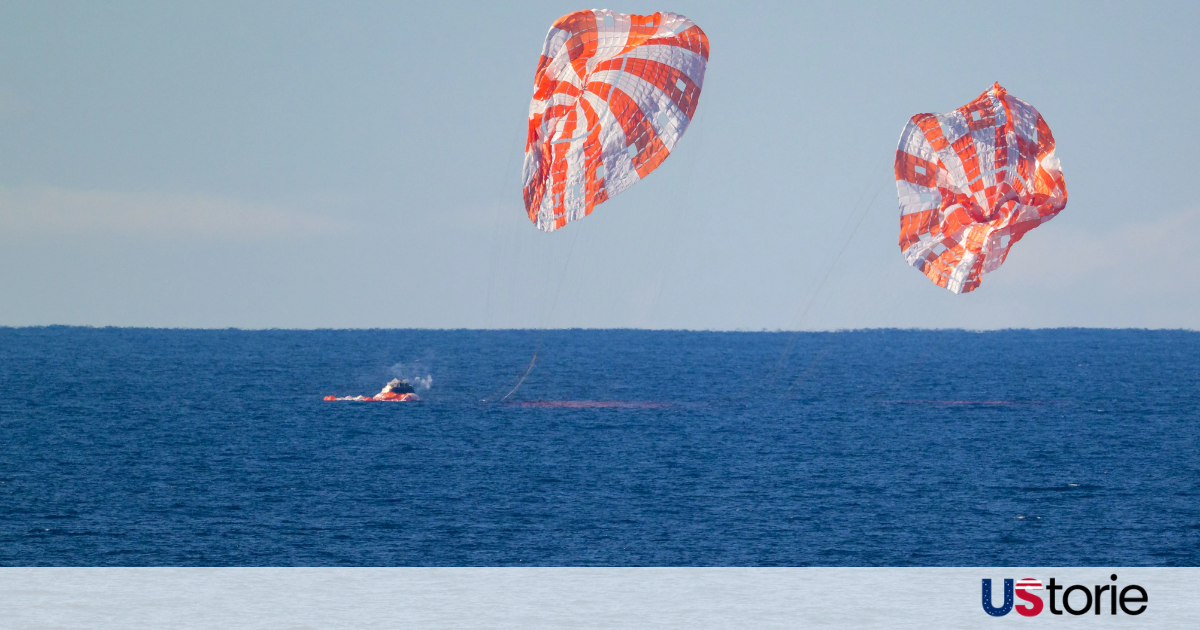
For the first time in over five decades, humanity has ventured to the moon and returned safely to tell the story. On Friday evening, April 10, 2026, the Artemis II splashdown officially concluded a 10-day “whirlwind” journey, as the Orion spacecraft, appropriately named Integrity, dropped into the Pacific Ocean off the coast of San Diego.
The mission, which sent four astronauts—Commander Reid Wiseman, Pilot Victor Glover, and Mission Specialists Christina Koch and Jeremy Hansen—further into deep space than any humans before them, is being hailed as a “bull’s-eye” success for NASA and its international partners.
The 25,000 MPH Homecoming
The return to Earth was a violent, high-stakes test of engineering. To make it home, the Integrity capsule had to punch through the Earth’s atmosphere at nearly 25,000 miles per hour—roughly 33 times the speed of sound. During peak heating, the exterior of the craft reached a scorching 5,000 degrees Fahrenheit, creating a red-hot sheath of plasma that temporarily cut off radio communication.
According to the NPR report on the Artemis II return, the “fireball” descent lasted 13 minutes before a series of parachutes deployed, slowing the capsule to a gentle 15 mph for splashdown at 5:07 p.m. PDT. “We sent four amazing people to the moon and safely returned them for the first time in more than 50 years,” said Lori Glaze, NASA’s head of planetary science. “Welcome to our moonshot.”

For a look at the “Earthset” photos captured by the crew as they looped around the far side of the moon on April 6, UStorie has published a high-resolution gallery titled “The Oasis in the Void”.
Life on the Far Side: 700,000 Miles Later
The mission wasn’t just a flight—it was a rigorous test of survival. Over the course of 10 days and more than 700,000 miles, the crew tested Orion’s life-support systems, navigation, and even the waste management systems in deep space. Victor Glover, looking back at the planet from a quarter-million miles away, described Earth as a “beautiful oasis” in a universe that is largely “a whole bunch of nothing”.
This perspective is a primary focus of our US News science desk. We are examining how the physiological data collected from the crew—including the impact of deep-space radiation—will inform the much longer missions planned for the lunar surface and, eventually, Mars.
What’s Next: The Hand-Off to Artemis III
NASA isn’t resting on its laurels. Even before the crew arrived at Johnson Space Center in Houston for their post-flight evaluations, work had already accelerated at Kennedy Space Center. The success of Artemis II serves as a green light for the Artemis III mission, which aims to land the first woman and first person of color on the lunar surface.
To see the updated launch schedule and the hardware delivery status for the next SLS rocket, visit our Sports and Lifestyle section, which covers the logistical and cultural impact of the new space race.
The “Relay Race” Mentality
Christina Koch described the Artemis program not as a series of isolated events, but as a “relay race.” The Artemis II crew even carried physical batons to symbolize the data and experience they are handing off to the next group of explorers. “Every single thing we did was with the next crew in mind,” Koch stated shortly before splashdown.
At UStorie, we are monitoring the selection process for the Artemis III landing crew. With the Integrity capsule now back on shore for detailed inspection, the data retrieved will be the foundation for the most ambitious landing attempt in history.
Final Thoughts: A Generational Achievement
The Artemis II splashdown 2026 is more than just a successful flight; it is proof that the “Artemis Generation” has arrived. By surviving the most extreme re-entry conditions ever faced by a crewed spacecraft, these four astronauts have opened the door for a permanent human presence on the moon.
The journey home is over, but the road to the lunar south pole is now wide open.