
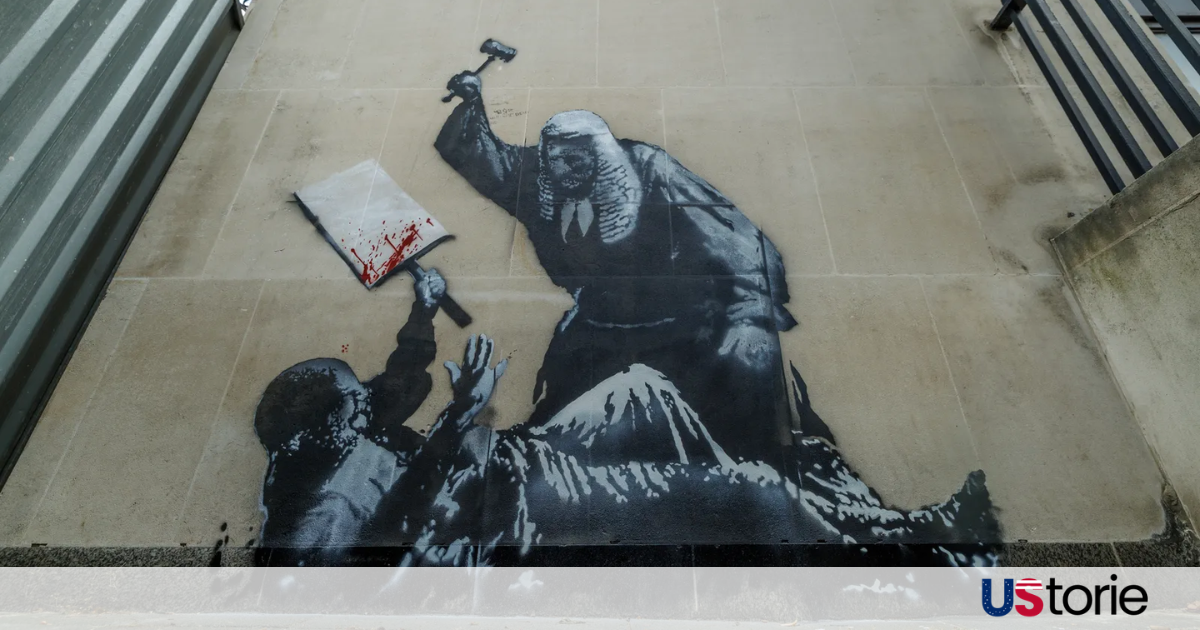
The mystery that has defined the contemporary art world for three decades may have finally been solved—not by a high-stakes sting or a gallery slip-up, but by a dusty administrative record from the turn of the millennium. A groundbreaking investigation has linked the world’s most elusive graffiti artist, Banksy, to a specific 26-year-old police report from New York City. The report identifies a man named Robin Gunningham as the individual behind a misdemeanor committed in the year 2000, providing the strongest evidentiary link yet to the artist’s true identity.
For years, the name Robin Gunningham has circulated in art circles as the most likely candidate for the Bristol-born stencil genius, but definitive “proof” has always remained out of reach. This new discovery, however, places Gunningham in the right place at the right time, engaging in the exact type of “vandalism” that would later become worth millions on the global auction block.
The New York Connection: A Misdemeanor in 2000
The investigation, as highlighted in a recent report by The Times, centers on a police record detailing a minor arrest in New York City during the summer of 2000. At the time, Banksy was reportedly in the United States for his first major North American “tour,” leaving his signature stencils across various Manhattan neighborhoods.
The report lists Robin Gunningham as the individual apprehended for a “graffiti-related misdemeanor.” While the charges were minor and eventually settled, the biographical details—including his age, birthplace, and physical description—align perfectly with what is known about the artist’s early years. This paper trail bridges the gap between the anonymous street tagger and the man who would eventually auction a self-shredding painting for $25 million.
For a closer look at Banksy’s most iconic New York works and how they transformed the city’s urban landscape, UStorie has published an archival gallery of the 2000 “Banging Your Head Against a Brick Wall” era.
Geographic Profiling: The Case for Gunningham
This isn’t the first time science and paperwork have pointed toward Gunningham. In 2016, researchers at Queen Mary University of London used “geographic profiling”—a technique typically used to catch serial killers—to analyze the locations of Banksy’s art. They found a statistically significant cluster around Gunningham’s former residences and social haunts in Bristol and London.
However, the 2000 New York police report is being hailed as the “smoking gun” because it provides a legal, third-party verification of Gunningham’s presence in a specific city at the exact moment a Banksy “artistic breakout” occurred. This intersection of law enforcement records and art history is a primary focus of our US News cultural desk, where we track how digital archives are dismantling the anonymity of the pre-internet age.
What This Means for the “Banksy Brand”
The reveal of a real name poses a fascinating question for the art market: Does the value of a Banksy lie in the art itself, or in the mystery of the artist? Some experts believe that “unmasking” Banksy could actually decrease the value of his future works by stripping away the counter-culture allure of his anonymity. Others argue that Gunningham’s status as a “known quantity” only adds to the mythos, proving that he successfully outran the world’s media for nearly 30 years.
To see how the 2026 art market is reacting to this news and which Banksy pieces are currently trending in international auctions, visit our Sports and Lifestyle section, which covers the high-stakes world of fine art investment.
The Artist’s Response (Or Lack Thereof)
As per usual, Banksy’s official representatives, Pest Control, have remained silent regarding the police report. The artist has spent decades maintaining that “anonymity is my greatest tool,” allowing the work to speak for itself without the baggage of celebrity. Whether this report marks the end of the mystery or just another chapter in a long-running game of cat and mouse remains to be seen.
At UStorie, we are continuing to investigate the legal implications of this reveal. If Banksy is officially confirmed as Gunningham, it could open a “Pandora’s box” of copyright issues and potential historical vandalism claims from property owners across two continents.
Final Thoughts: The End of an Era?
In 2026, the concept of “privacy” feels like a relic of the past. If the world’s most famous invisible man can be tracked down via a 26-year-old misdemeanor, it suggests that no secret is safe from the relentless march of digital investigation. Robin Gunningham or not, the impact of Banksy’s work on the 21st-century cultural consciousness is undeniable.
The report may give us a name, but it doesn’t change the message. As Banksy once famously wrote: “Graffiti is one of the few tools you have if you have almost nothing. And even if you don’t come up with a picture to cure world poverty, you can make someone smile while they’re having a piss.