
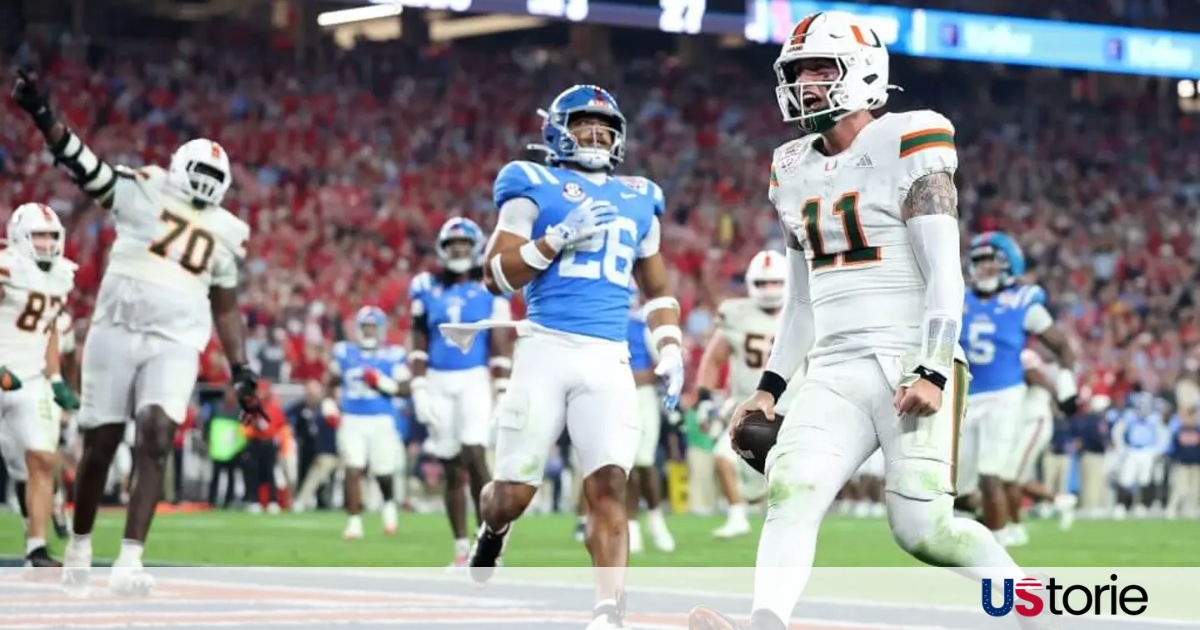
For once, college football didn’t ask fans to trust a committee or debate a ranking. It asked them to watch. Under playoff lights, Miami Hurricanes and Ole Miss Rebels settled their season the only way that ever feels fair by lining up and playing. The semifinal wasn’t flawless, but it was honest, and in that honesty was a reminder of what the sport becomes when opportunity replaces argument.
A Game That Refused to Follow the Script
From the opening kickoff, it was clear this semifinal wouldn’t follow expectations. Miami’s speed challenged Ole Miss early, while Ole Miss responded with physicality and composure. Momentum shifted multiple times, not because of rankings or resumes, but because players made plays when it mattered.
There were missed tackles. Questionable decisions. Momentum swings that felt sudden and emotional. And yet, that chaos is exactly what playoff football is supposed to look like.
Instead of arguing over who “looked better” in December, fans got to watch it unfold in real time.
Why Expansion Makes Games Like This Possible
This matchup likely never happens in a smaller playoff format. For years, similar teams were left watching from home while debates raged on television. Expansion changed that dynamic.
More teams didn’t dilute the product they sharpened it.
Miami and Ole Miss both entered the playoff with doubters. Neither was viewed as flawless. But when given the chance, they delivered a semifinal that felt earned rather than assigned. The result wasn’t theoretical. It was settled snap by snap.
For ongoing U.S. sports and football coverage, visit
https://ustorie.com/category/us-news/
Players, Not Committees, Took Control
What stood out most wasn’t just the scoreline it was the emotion. You could see it on the sidelines. Coaches reacting in real time. Players adjusting, improvising, and occasionally failing under pressure.
That human element disappears when seasons are decided by conference politics or brand recognition. This semifinal put control back where it belongs: with the athletes.
College football has always thrived on unpredictability. Expansion didn’t remove tradition it restored competition.
The Atmosphere Felt Different And Better
The energy inside the stadium reflected what fans have been asking for. No one was checking rankings mid-game. No one cared about hypothetical matchups. The stakes were immediate.
Win and move on. Lose and go home.
That clarity cut through years of frustration. It reminded everyone why playoff football should be about opportunity, not exclusion.
Technology, replay systems, and modern broadcasting have amplified moments like this, bringing fans closer to the action than ever before. That evolution of the sport continues to be explored here:
https://ustorie.com/category/technology/
What This Means for College Football’s Future
The Miami–Ole Miss semifinal didn’t solve every problem in college football. But it made one thing obvious: expanding the playoff didn’t weaken the sport it strengthened it.
More teams mean more meaningful games. More urgency. More chances for programs to define themselves on the field instead of in arguments.
Not every expanded-playoff game will be dramatic. Not every matchup will be close. But when it works, like it did here, it delivers something rankings never can clarity.
Let the Game Decide
College football doesn’t need fewer voices. It needs fewer gatekeepers.
This semifinal was proof that when teams are given the chance to settle things on the field, the sport becomes fairer, louder, and more honest. Miami and Ole Miss didn’t need permission. They needed an opportunity.
And they took it.
For more in-depth college football stories and playoff analysis, visit
https://ustorie.com/