

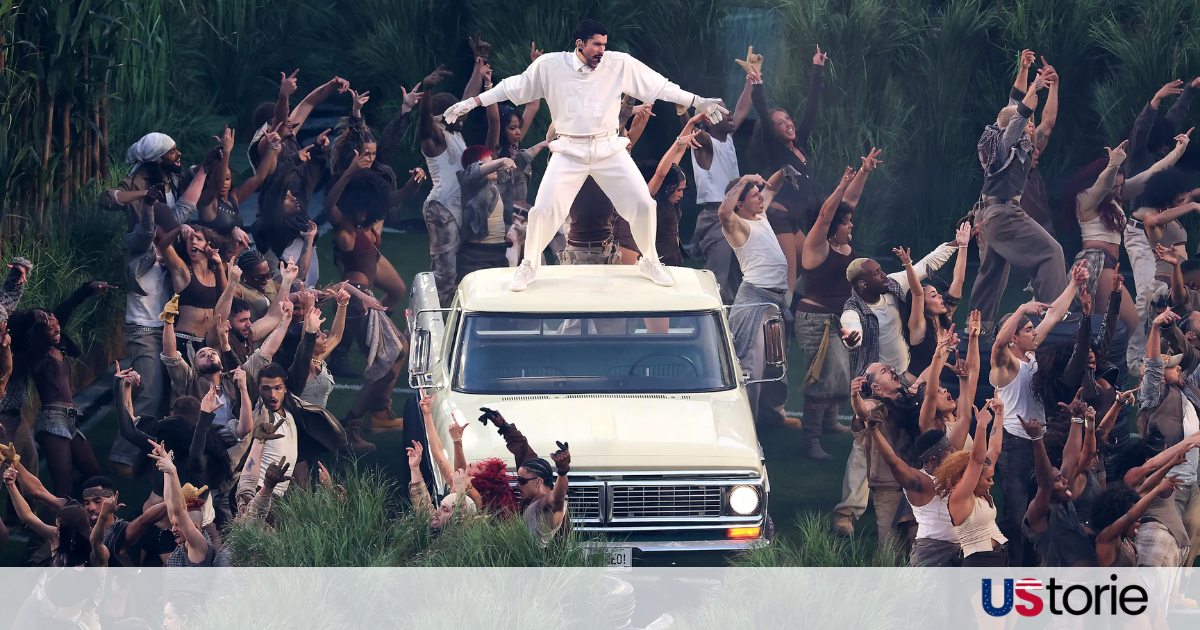
When Bad Bunny took the field for the 2026 Super Bowl halftime show, few expected anything that looked like a history lesson. A 13-minute set isn’t a university lecture, but in Santa Clara, California, the Puerto Rican superstar delivered one anyway with music, imagery, pride, and personal meaning woven into every beat.
From the moment he emerged amidst towering sugar cane stalks to the final chorus, the performance was more than a spectacle. It was storytelling, it was cultural affirmation, and for many, it felt like the most human moment of the entire NFL season.
Bad Bunny born Benito Antonio Martínez Ocasio didn’t just play songs. He used his platform to honor his heritage, to bring Puerto Rico into an arena historically dominated by glossier pop interpretations, and to show the world that identity and joy can coexist on the biggest stage imaginable.
A Performance Steeped in Identity
This was not your typical halftime show.
Bad Bunny performed mostly in Spanish a first in the nearly 60-year history of Super Bowl halftime performances and filled the stage with imagery drawn from Puerto Rican life. The set featured sugar cane fields, models of bodegas and neighborhood bars, vibrant scenes of community life, and even a real wedding.
Rather than relying on American pop clichés, he brought authenticity to the moment. The vibe wasn’t polished in the usual blockbuster style it was honest. It was personal. And that made it feel weirdly intimate for something watched by tens of millions of people.
For fans who follow how culture, music, and identity intersect in storytelling, platforms like UStorie regularly dig deeper into moments like this beyond just the surface headlines.
https://ustorie.com/
Music, Symbolism, and A Shared Message
The setlist covered songs from his Grammy-winning album Debí Tirar Más Fotos and earlier hits like “Tití Me Preguntó.” But what made this different wasn’t just the hits it was how they were framed.
There were scenes referencing Puerto Rico’s frequent power outages, dance breaks that felt like street celebrations, and appearances from artists like Lady Gaga and Ricky Martin that linked cultural legacy with the present moment.
In many ways, it was a celebration of roots not just as nostalgia but as living, breathing, current experience. This wasn’t nostalgia dressed up for mass appeal. This was identity worn proudly, on a stage where millions of Americans and international viewers could see it.
Some critics found the package confusing or controversial partly because it was almost entirely in Spanish and partly because it didn’t fit some people’s idea of “American” entertainment. But for many others, it didn’t alienate viewers it invited them to understand something new.
These kinds of cultural layers are exactly what UStorie’s US News coverage often brings into context, looking at how moments that seem entertainment on the surface reflect deeper conversations in society.
https://ustorie.com/category/us-news/
A Story About Pride, Not Just Performance
Perhaps the most striking moments weren’t the pyrotechnics or the choreography they were the narratives.
At one point, Bad Bunny handed one of his Grammys to a young boy in the crowd. That wasn’t showmanship. It was intention. It was saying, “I was once in your shoes.” It was passing the message of hope to the next generation.
Later, as the performance closed, the stadium visuals displayed large text saying: “The only thing more powerful than hate is love.” Flags of countries from across the Americas waved on screen. It wasn’t just a nod to inclusion; it was a declaration.
For many watching in Puerto Rico, the mainland U.S., and beyond, it felt like a collective moment of acknowledgment. People paused, cheered, and shared their pride not just because the music was good, but because representation finally felt complete.
This kind of impact doesn’t just live in social media feeds. It ripples through communities, playlists, late-night conversations, and everyday moments when someone hears a familiar beat and remembers who he represents.
Divided Reactions, Shared Conversations
Of course, not everyone saw it the same way. Some critics dismissed the show as too political or said it felt alien to viewers who didn’t understand Spanish. Others even created alternative viewing events for halftime. Regardless of opinions, the reaction was passionate, and that in itself says something: the performance sparked conversation.
Pop culture moments that become talking points tend to reflect bigger themes in society and that’s what happened here.
For readers who enjoy dissecting how music intersects with identity and social context, UStorie’s Entertainment section often looks at how big cultural moments shape public discourse.
https://ustorie.com/category/entertainment/
A Milestone Not Just Another Halftime Set
As the dust settled, many commentators called Bad Bunny’s Super Bowl set one of the most meaningful ever. It wasn’t just about performing in Spanish for the first time. It was about bringing context with the performance the struggles, the communities, the celebrations, the history.
It was a story told through color, rhythm, energy, and meaning and it stuck.
For the full detailed review and historical context as presented by critics and journalists, The New York Times also covered the performance’s cultural significance.
And even days later, people are still talking about it. Some loved it. Some didn’t. But almost everyone agrees on one thing: Bad Bunny turned a global sporting spectacle into something that felt deeply personal and broadly human.
In the end, that’s the closest thing to a lesson you can teach from a stage like the Super Bowl halftime show.